FAQ

Help us keep our woodland safe and tidy…
While we endeavour to maintain Rhubodach to a high standard, you can help us too.
Please send us photos and details if you notice anything that doesn’t look right.
FAQ
How do I find Rhubodach and Johnny’s Way?
Access and parking for our woodland, as well as the Bute Community Forest, which is adjacent, can be found by parking at the Rhubodach-Colintraive Ferry and walking north past the slipway, into farmland. There will be signposts to the WWII Bunker, Balnakailly, and Johnny’sWay. Access our map and Bute Community Forest website for more information.
Is there livestock?
In parts of your walk, there may be livestock. Please don’t disturb the animals, and if you have dogs, keep them on a leash at all times.
What else can we see?
In the same area along the walk up, you can find Balnakailly Settlement, as well as a World War II bunker used in Operation Starfish. You will also find many animals, birds, fungi, and plants of interest. Parts of the walk are designated as a Site of Special Scientific Interest (SSSI).
Who owns Rhubodach?
Rhubodach, which spans 309 hectares at the northern end of Bute, is owned by Tallwood Ltd, a company held by the Bute and De Lisser family.
To access Rhubodach you will walk up through Private Farmland and sections owned by Bute Community Forest.
When will Rhubodach Forest be finished?
Rhubodach, the section owned by Tallwood Ltd on the north end of Bute, has a felling and re-plantation schedule. Felling and re-planting occur over the summer. We ask you to stay on the paths for Johnny’sWay and the Bute Community Forest, for your own safety. Currently, we aim to complete felling by 2034, with 270 Hectares to go. When other sections are open to roam, we will share on our social media.
What happens when there’s been a storm?
During the year, we typically get a few big storms, which can cause significant tree fall, especially in the older sitka spruce plantations. If you know there has been high winds or storm conditions, avoid walking Rhubodach and Johnny’sWay until we have said it is clear on our social media.
What do I need for my walk?
Be prepared, wear appropriate footwear, wet weather gear, and tread carefully; areas can be wet and boggy. Always tell someone where you are going. Adhere to all signs.
Please keep to paths throughout the walk and be mindful of where you step, as the area is an SSSI. You may find areas of standing water. Please oversee children throughout your walk.
Can we touch the stones?
Yes, the carvings and bench are meant to be touched, explored, and ideally will, over time, form moss and lichen, becoming a part of the landscape and perhaps less visible in future years.
However, please be mindful of the stones; we want them to last the test of time. Please get in contact with us if you think a stone may be damaged.
When will Johnny’s Way be finished?
We are aiming to complete Johnny’s Way by the early 2030s. Due to the nature of the project, selecting local stones and sourcing other materials from Scotland, we don’t have an exact completion date. Follow our social media for news on our makers, when we put new stones in and other updates.
More interpretation and signage is due to go in 2026.
Can I access fenced areas?
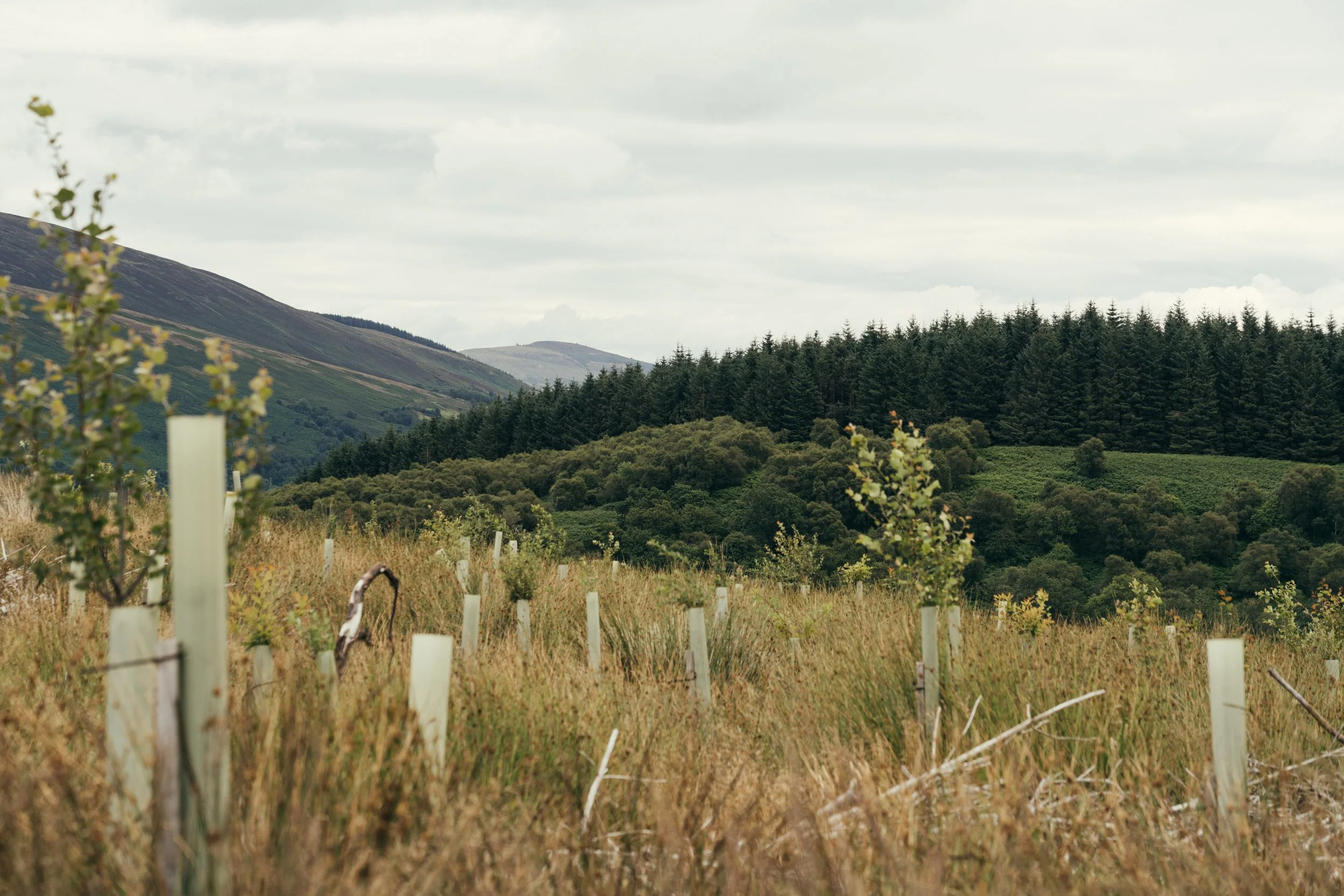
Please stay out of fenced areas, we have fenced off areas to protect the young trees from deer. Fences may also indicate live forestry in that section. Please always follow signage. When live forestry is underway, it is not permissible to be in certain areas for your safety.
What Native Broadleaf trees are being planted?
You will find Oak, as well as various Birch, Alder, Aspen, and Scots Pine.
What do we hope to achieve by planting these trees?
The biodiversity of our woodlands has been lost to commercial planting. Sitka Spruce vastly reduces the biodiversity of its surroundings. By felling and re-introducing native broadleafs, we can restore these complicated ecosystems, which will serve multiple environmental and social purposes.
locking away carbon
promoting the complicated processes required for healthy ecosystems
bringing back absent plant, bird, mammal, insect and fungi species
community, a place for people to freely explore nature art, promoting well-being